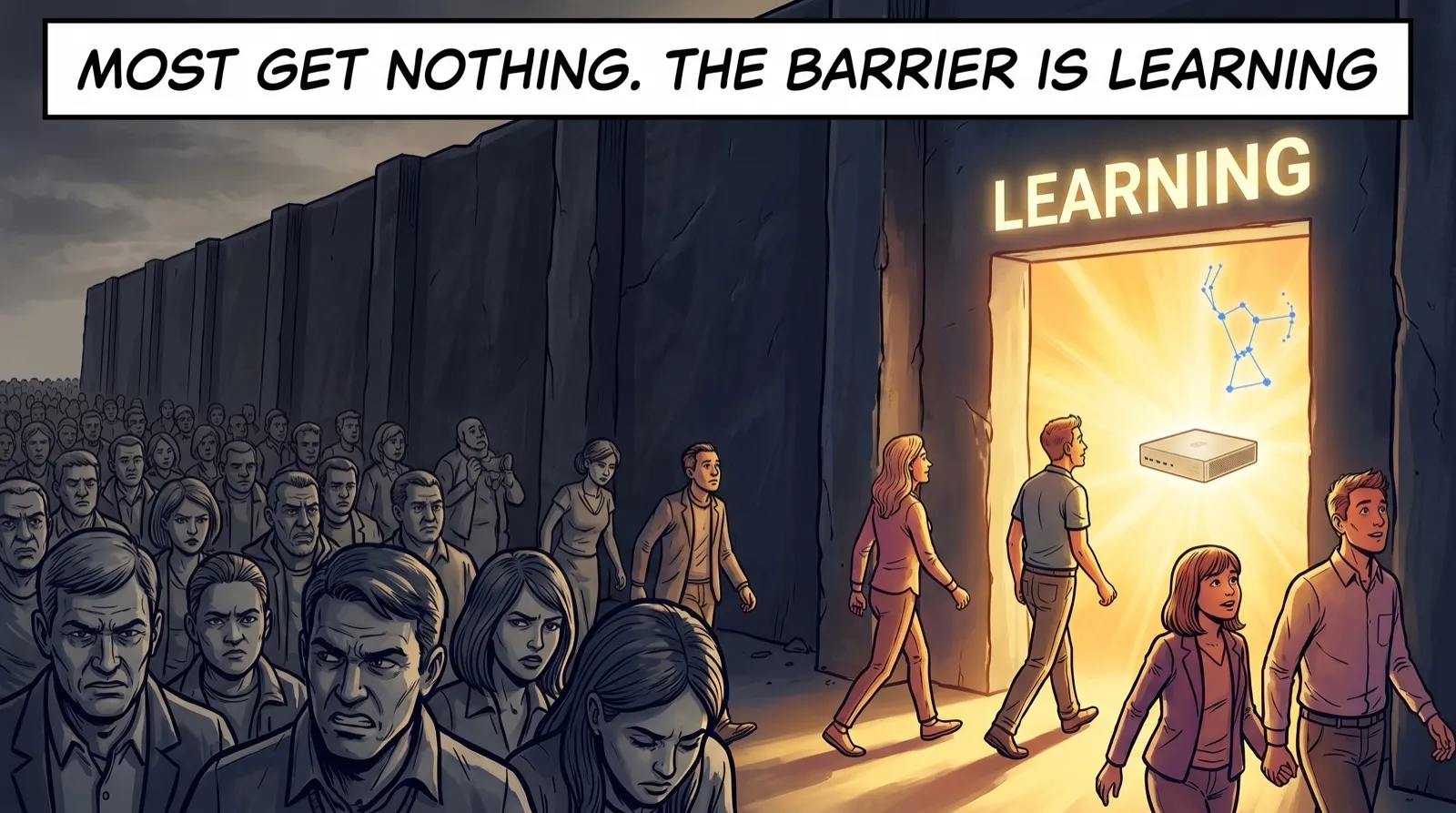
Why most teams get nothing from AI
Companies poured 30 to 40 billion dollars into AI and 95% got nothing back. The reason is not cost or tech. It is learning. That gap is why Orionfold exists.
Here is a number that should stop you. Companies poured between 30 and 40 billion dollars into AI. And 95% of them got nothing back. Not a little. Nothing. I want to tell you why, because it is the whole reason Orionfold exists.
The divide
A 2025 study from MIT, called the GenAI Divide, laid it out plainly. Of all that money spent on AI, only about 5% of projects pulled real value out, millions of dollars of it. The other 95% got zero return.
So a few teams win big, and almost everyone else gets nothing. That split is the divide. And once you see it, you cannot unsee it.
The reason is not what you think
You would guess the problem is money, or missing technology, or rules, or a shortage of smart people. The study says no. In its own words:
“The core barrier to scaling is not infrastructure, regulation, or talent. It is learning. Most GenAI systems do not retain feedback, adapt to context, or improve over time.”
Read that twice. The barrier is learning. The people have not learned to use AI well, and the systems are not learning either. The tools are sitting right there, cheap and capable, as the earlier stories showed. The gap is knowing how to use them.
What the patterns show
A couple of the findings stuck with me.
Teams that brought in outside help succeeded about twice as often as teams that tried to build everything alone, inside. And the biggest companies ran the most experiments but scaled up the fewest of them. More money and more pilots did not win. Learning won.
It makes sense when you sit with it. New AI tools land every single week. A plan you wrote once, a year ago, cannot keep up with that. If you are not learning all the time, you fall behind all the time.
Why this is the gap I aim at
This is the exact gap Orionfold is built for. If the barrier is learning, then the answer is not one more locked, expensive platform. The answer is the stuff that actually helps you learn and own it. Real playbooks and build stories. Open tools you can run and take apart. AI shaped to the way you work.
A tool that some friends of mine built, NeoSignal, puts the goal in a nice phrase. Compress months of learning into minutes. That is the job. That is the side of the divide I want to put people on.
The line I keep coming back to
People worry that AI will make them obsolete. I think that is the wrong fear. AI will not make you obsolete. Not learning AI will.
The divide is real. Which side you land on is mostly about whether you keep learning, and whether you own your tools or merely rent them.
So what do you actually do about it? You take hold of the few things you can truly control. There are four of them: Four things you actually control.
- AI Native
- Conviction
- Building in public