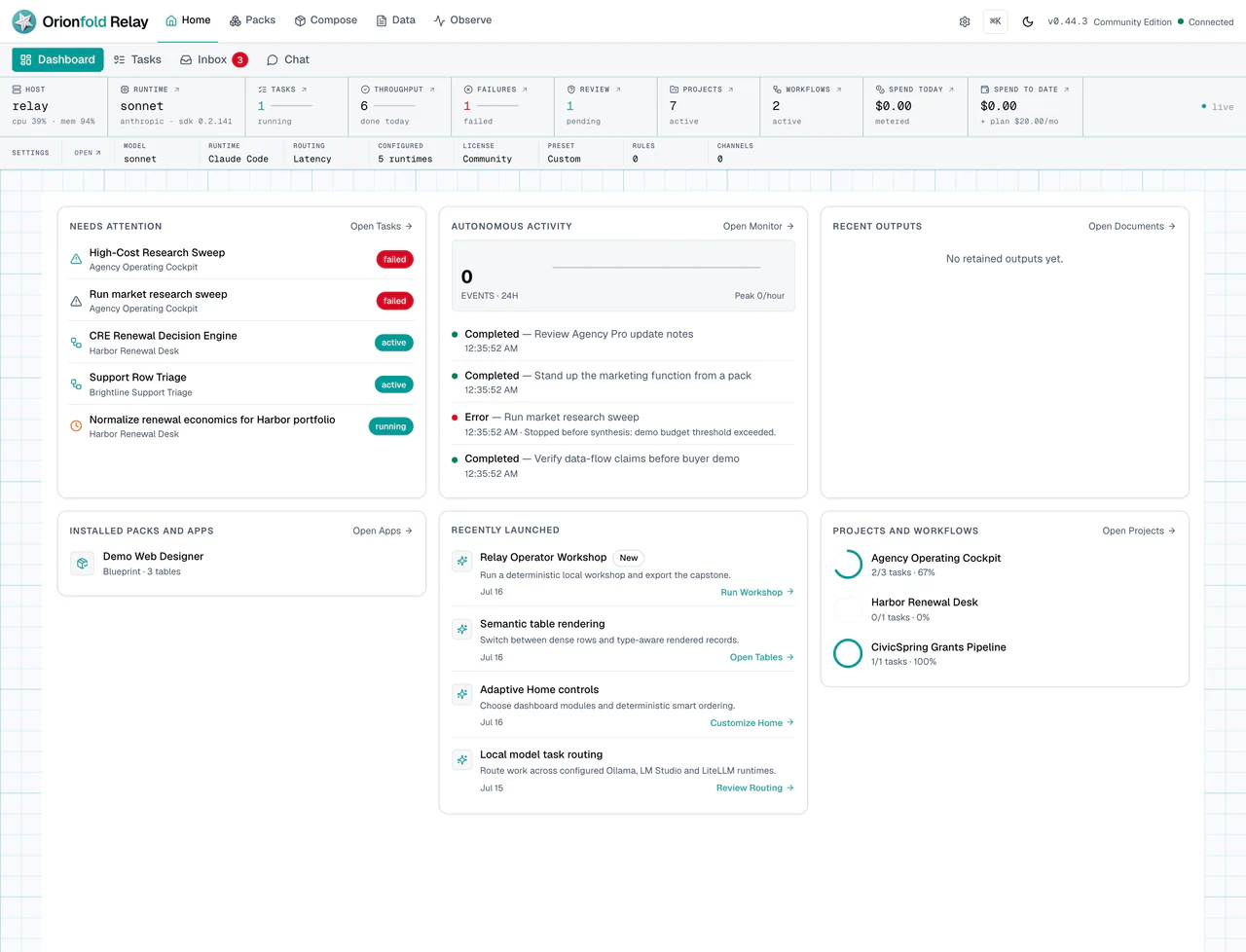
This group is for a developer standing up or integrating a local Relay instance. It covers the routes that report where Relay is running, discover and import nearby projects, repair the data directory for a cloned instance, and feed the command palette its recent items. Read this first if you are automating first-run setup, wiring Relay into an existing project layout, or building a tool that needs to know the current workspace.
Stability
platform
These routes are documented for developers to build on. They report and change local instance state, so their inputs and outputs are meant to stay stable across releases. The one exception is POST /api/context/batch, which is an app-internal moderation route included here for completeness; treat its shape as subject to change.
Local Access Model
Relay API routes run inside the local Relay app. Use http://127.0.0.1:<port> in examples, where <port> is the port your instance is bound to (3000 by default).
Do not expose these routes on a public network without your own access controls. Several of them read and write local files (.env.local), create directories, and open the local SQLite database.
Endpoint Families
context
workspace
command-palette
Endpoints
Method(s)
Path
Stability
Source
GET
/api/command-palette/recent
platform
src/app/api/command-palette/recent/route.ts
POST
/api/context/batch
app-internal
src/app/api/context/batch/route.ts
GET
/api/workspace/context
platform
src/app/api/workspace/context/route.ts
POST
/api/workspace/discover
platform
src/app/api/workspace/discover/route.ts
POST
/api/workspace/fix-data-dir
platform
src/app/api/workspace/fix-data-dir/route.ts
POST
/api/workspace/import
platform
src/app/api/workspace/import/route.ts
Endpoint Reference
GET /api/command-palette/recent
Returns the five most recently updated projects and the five most recently updated tasks, for the command palette recents list.
projects[].status is one of active, paused, completed. tasks[].status is one of planned, queued, running, completed, failed, cancelled. Each array holds at most five rows, ordered by most recently updated first.
Errors: none are returned explicitly. A database read failure propagates as an unhandled rejection.
Side effects: reads only.
POST /api/context/batch
Batch-approves or batch-rejects learned-context proposals. This is an internal moderation route used by the Relay web app.
count is the number of proposals the action applied to.
Errors:
400 when validation fails: { "error": "proposalIds (string[]) and action ('approve'|'reject') are required" }.
500 on any processing failure: { "error": "<message>" }.
Side effects: writes new learned-context versions and updates related notifications. The approve path may trigger asynchronous context summarization for oversized profiles.
GET /api/workspace/context
Returns metadata about the directory Relay was launched from: folder name, git branch, worktree status, and the resolved data directory.
Request: none.
Response200, with header Cache-Control: private, max-age=60:
gitBranch is null when the launch directory is not a git repository or the branch cannot be read. dataDirMismatch is true when the running data directory differs from the one this workspace expects.
Errors: none are returned. Git and filesystem probes fail quietly, yielding gitBranch: null and isWorktree: false.
Side effects: reads only. Runs git branch --show-current with a short timeout and reads .git.
POST /api/workspace/discover
Walks a parent directory to find child projects that carry .claude or .codex markers, then flags which of them are already imported into this instance.
Request body (JSON):
Field
Type
Required
Notes
parentDir
string
yes
1 to 500 characters. A leading ~ or ~/ is expanded to the home directory.
maxDepth
number
no
Integer, 1 to 3. Defaults to 2.
markers
("claude" | "codex")[]
no
At least one entry. Defaults to ["claude","codex"].
alreadyImported is set by cross-referencing each discovered path against imported projects. errors lists per-directory scan failures; it does not mean the request failed.
Errors:
400 when validation fails: { "error": <zod flatten object> }.
400 when the expanded directory does not exist: { "error": "Directory not found: <path>" }.
Side effects: reads the projects table and scans the filesystem. No writes.
POST /api/workspace/fix-data-dir
For a cloned, non-main instance, derives ~/.<folderName> as the data directory, records it in .env.local, creates the directory, and bootstraps an empty SQLite database there.
Request: none. The route derives everything from the launch directory and instance detection.
needsRestart is always true: the new data directory takes effect only after Relay restarts.
Errors:
400 when run in the main dev repository: { "error": "Main dev repo does not need a data-dir fix" }.
400 when the instance is already isolated to a non-default data directory: { "error": "AINATIVE_DATA_DIR is already set to a non-default path" }.
Side effects: rewrites .env.local to set RELAY_DATA_DIR, creates the data directory, and opens a new SQLite database at <dataDir>/relay.db to bootstrap its schema.
POST /api/workspace/import
Imports a list of projects into the instance, scans each one’s environment, and streams per-project progress as Server-Sent Events.
Request body (JSON):
Field
Type
Required
Notes
projects
{ path: string, name: string }[]
yes
At least one entry. path 1+ chars, name 1 to 100 chars.
Response200, streaming, with headers Content-Type: text/event-stream, Cache-Control: no-cache, Connection: keep-alive. Each SSE frame is one JSON object:
A project that fails to import emits { "type": "progress", "index": 0, "name": "acme", "status": "failed", "error": "string" } instead of a done frame, and the stream still ends with a complete frame.
Errors:
400 when validation fails: { "error": <zod flatten object> }, returned as a normal JSON response rather than a stream.
Side effects: inserts one project row per entry, then scans each project’s environment and records the scan. A scan failure is caught and does not block that project’s creation.
Examples
Read the current workspace context:
Terminal
curl http://127.0.0.1:3000/api/workspace/context
Discover projects two levels under a parent directory:
The -N flag keeps curl from buffering, so you see each SSE frame as it arrives.
Do Not Depend On
GET /api/command-palette/recent and POST /api/workspace/fix-data-dir have no error handling. A database or filesystem failure surfaces as an unhandled rejection, not a structured error body. Do not rely on a specific error shape from these two routes.
The count returned by POST /api/context/batch reflects rows the action changed, which can be lower than the number of ids you sent if some were already resolved.
POST /api/workspace/fix-data-dir reads no request body; its entire behavior is derived from the launch directory. Do not assume you can point it at an arbitrary path.
The exact contents of the Zod flatten error object returned on validation failures may change with schema edits. Branch on the 400 status, not on the internal structure of error.
Orionfold Relay
Run your AI team from one place.
The engine is free and open. A license unlocks the premium packs you own and keeps them yours, offline. Founding seats from $349.