 ORIONFOLD
Write your method once.
Every client gets the living version.
Easily co-author with any AI once, one-click publish as AI system everywhere.
Month-end close
For Juniper Bakery
- Pull the month’s numbersTALLY DOES THIS
- Explain every change over 5 percentTALLY DOES THIS
- Call the client if cash and profit disagreeYOUR CALL
A Playbook, at its smallest. Step 3 stays yours.
You have the method.
It keeps starting over.
A Playbook keeps your method, its sources and your corrections in one place, so the next client starts from what you already learned.
- Every client starts from a blank chat.Your method lives in your head, old decks and a dozen past conversations. On each new job you explain it to the AI again.
- Last month’s fix is gone.You corrected the AI on a client job. The next session does not know. The lesson stays in that one file.
- The draft is fast. Checking it is not.AI writes in seconds. Then you spend the evening making sure it says what you mean before a client sees it.
Why now
OpenAI retires custom GPTs on December 11, 2026. A Playbook is plain Markdown in your own GitHub, and the files still open anywhere.
Source: OpenAI Help: Custom GPT retirement and migration FAQ, checked 2026-10-27 ↗
One folder.
Everything you know about the job.
Your know-how, your sources, and tools your clients use on their own work. Here is the first one, file by file, as it sits on GitHub.
- README.md The front page. Who it is for, what you will have at the end, and the path. Stepped figure Map of the path
- Mechanisms Primer.md What a mechanism is, how to spot a missing one, how to build one. Checklist Tables Stepped figure
- Amazon Mechanisms and Practices.md 24 mechanisms described in public, each with a source. Reference table Sources Marked to check
- Press Release FAQ for AI project.md Work backwards from the customer before you build. Template Review figure
- Pilot to Scale.md Run a pilot that answers a real question, then take it to production. Pilot card Readiness check
- Flow PR-FAQ.md A worked example. The PR/FAQ for Flow’s own launch. Worked example
- 01Plain files you ownEvery document is Markdown in a folder. It opens in any editor and lives in your GitHub, not ours.
- 02Tools, not only textFigures a reader steps through, checklists they tick, tables they fill in for their own work.
- 03Sources and open questionsClaims link to where they came from. What is not checked yet is marked, and counted, until you answer it.
- 04An author, a version, a licenceReaders see who wrote it and which version they hold. Updates arrive as changes they review.
How it travels to a client
From your Mac to your client's Flow, or to their agent through Flow. AI Consulting travels as 6 files and 75 KB. Publish again, and every client gets a change to review.
Publisher
YouThe method is yours
Your AICo-writes in Chat
- Chat wrote the README: 788 words, 2 claims marked to check
- A skill drew its figure. You kept it.
- Publish ▸ GitHub Repository
The Playbook
ai-consulting-starter
- README.md
- Mechanisms Primer.md
- Amazon Mechanisms and Practices.md
- Press Release FAQ for AI project.md
- Pilot to Scale.md
- Flow PR-FAQ.md
6 files · 75 KBCC BY 4.0
Plain Markdown, lighter than one photo from your phone. It opens in any editor.
Your client, in Flow
- ElementsFigures, tables and checklists draw. The README’s figure plays all four steps, with no model run.
- SkillsThe skills your method uses are ready to run on their own work.
- JobsA Job refreshes a document from their own files when they ask.
- UpdatesYour next publish arrives as a change they review, file by file.
Their agent, through Flow
Claude Code or Codex
- Reads the summary and reading order
- Searches the documents
- Uses your method in its own work
- Sends what it writes to Review Changes
New in Flow 4. Bring a Playbook in from GitHub and choose which updates to take
Two Playbooks,
built and published.
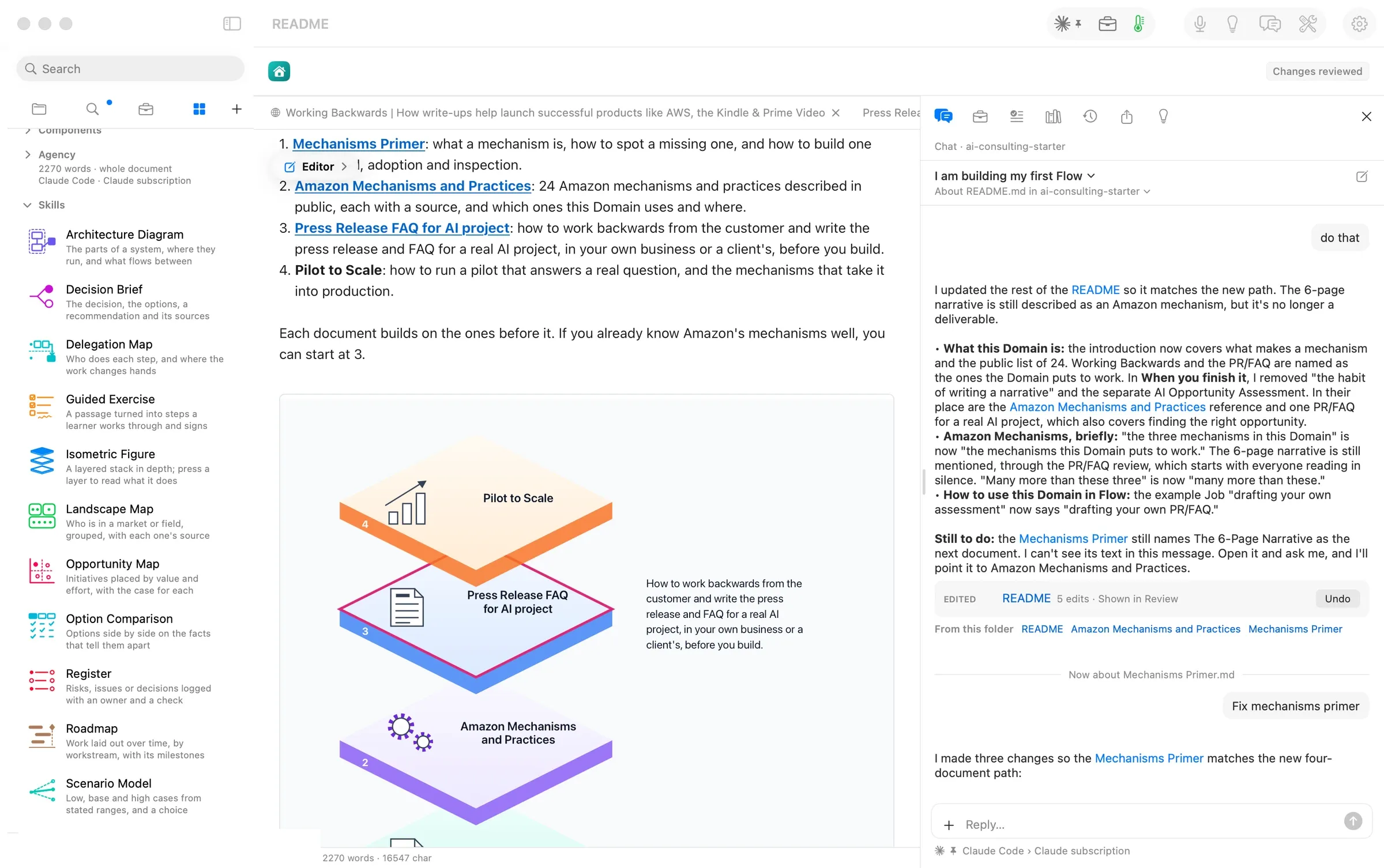
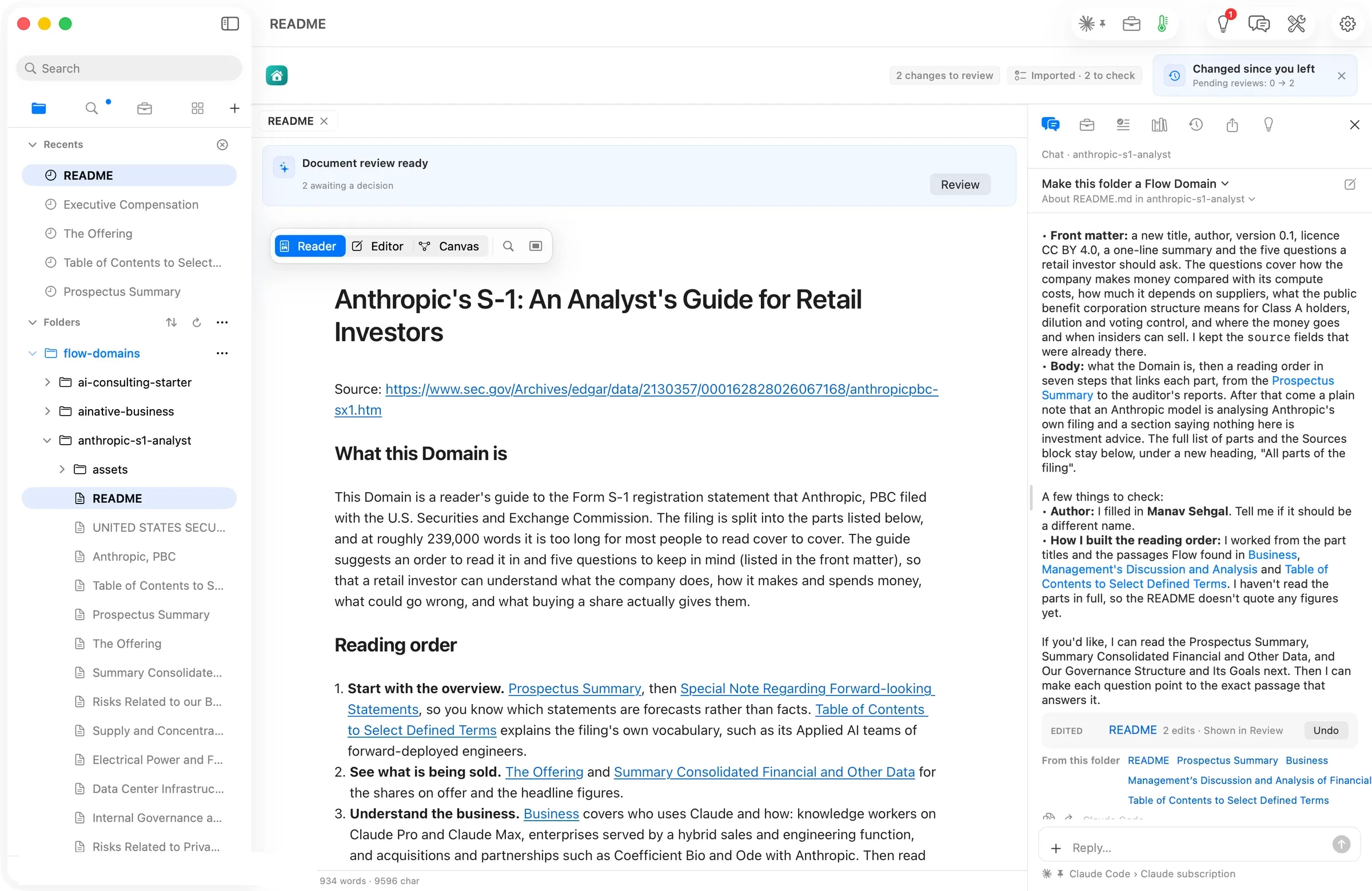
Manav Sehgal built each one in Flow and published it to GitHub. Each took about three hours of hands-on work, and no run cost anything on top of a Claude subscription.
- The launch story · AI and management consultants
AI Consulting
Nine years of Amazon mechanisms, built into a Playbook and published to GitHub in a few hours.
- Files
- 6 Markdown, 75 KB
- Hands-on
- About 3 hours, over two days
- Licence
- CC BY 4.0
- Founder Playbook · Investors and analysts
Anthropic S-1 Analyst
Anthropic's 243,000-word S-1, read into a guide with five questions and published as a Playbook in an afternoon.
- Files
- 42 Markdown, 1.7 MB, with 42 pictures
- Hands-on
- About 3 hours, in one afternoon
- Licence
- CC BY 4.0
The first one, hour by hour
AI Consulting turns nine years of Amazon mechanisms into a path for adopting AI. Here is its walk across two days.
- Day 1 · October 25
- An empty folder Chat is ready before any document exists.
- The front page Chat writes the README in the author’s voice: 788 words, 2 claims marked to check.
- An old AI chat, cleaned up 24 Amazon mechanisms come in with their links, then get 14 sources.
- The first figure Ideas picks a Skill. About a minute later, a stepped figure waits in Review.
- The next document, past midnight The Mechanisms Primer, built from the author’s own pages in under 2.5 minutes.
- Day 2 · October 26
- Review cuts the path Six documents become four, and every page that pointed at the old path follows.
- Published Publish ▸ GitHub Repository: 6 files sent, nothing else touched.
- An update reaches a reader A licence is added. The reader’s copy shows the change to review.
Use a Blueprint
to create your own Playbook.
Blueprints we give away, one per field. Each shows what the Playbook would hold, the signals behind it, and the Flow steps to build it. Take yours, put your name on it, and launch it. None of them is built yet.
-
Learning Design
Your course method, your evidence on how people learn, and the questions that pull a method out of an expert.
For learning designers and trainers -
Research Synthesis
Your way of turning interviews into evidence a client can decide on, with the standards you hold yourself to.
For market research and insights consultants -
Finance Advisory
Your monthly reporting method, the rules you read the numbers by, and a board pack that carries both.
For fractional CFOs and finance advisors -
Accounting Advisory
Your monthly close, the plain-English note that explains it, and the research notes your clients ask for.
For accounting and tax advisors -
Executive Coaching
Your engagement method, the feedback and development plan it produces, and the close-out your sponsor reads.
For executive and leadership coaches -
Cybersecurity Advisory
Your assessment method, the policies and risk register that follow it, and the board report that explains it.
For virtual CISOs and security consultants -
Contract Review
Your issues list, your clause playbook with its fallbacks, and the redline memo your clients actually read.
For lawyers and contract specialists who review agreements for clients -
HR Advisory
Your handbook and policy set, your hiring scorecards, and the compliance calendar your clients ask about.
For HR consultants and fractional people leaders -
Product Management
Your discovery method, the opportunity tree and roadmap it feeds, and the launch checklist a team signs.
For product leaders and product coaches -
Grant Writing
Your funder register, your proposal template by section, and the boilerplate your clients keep asking for.
For grant writers and nonprofit fundraising consultants -
Financial Planning
Your discovery questions, the plan you build from them, and the annual review that keeps it alive.
For financial planners and wealth advisors -
Software Architecture
Your review checklist, the decision records behind each diagram, and the debt register clients ask for.
For fractional CTOs and architecture consultants -
Sales Enablement
Your ideal customer profile, your discovery call guide, and the deal scorecard your reps run each week.
For fractional sales leaders and enablement consultants -
Content Strategy
Your brand voice guide, the messaging map behind it, and the briefs and calendar your writers work from.
For content strategists and marketing consultants -
Your field is not here?
Tell Manav the client job you would build a Playbook for. The next blueprint could be yours.
Write to Manav
Your expertise.
Your clients. Your brand.
Built first for AI and management consultants. It fits any expert with a method they apply again and again, like learning designers and trainers or fractional CFOs and finance advisors.
- You subscribe to Flow. Your clients pay you.You set the offer, the price and the terms. Flow is not in between you and your clients.
- No fee per Playbook.Publishing needs Flow Pro and the Publish add-on, $10 a month each. Then publish as many Playbooks as you like. AI runs follow the terms of the service you connect.
- The method stays yours.Plain files in your own repository, under the licence you choose, with your name on them.
What publishing includes 4
Chat on the Playbook and its interactive tools stay in Flow. Exported files are for reading and delivery.
- A GitHub repositoryReaders bring the folder into Flow with one address, and get your updates as changes they review.Walked end to end for the first Playbook
- A GitHub Pages siteA website for your method. Figures play step by step.
- PDF and EPUBA guide or a book in a form every client can open.
- Word, Excel and PowerPointDeliverables your client’s team already works in.
Talk about your first Playbook. Email Manav the client job you would build it for, when it is due, what you use today, and what gets in the way. You get one reply, not a list.
Write to ManavYour agents,
on your Playbooks.
In Settings ▸ General ▸ Your agents, open Flow to the Claude Code or Codex you run in Terminal, as Read or Read and propose. Your agent can read a Playbook's summary and reading order, read and search its documents, and read a skill's method, then apply your method to the work it does for you. A document it proposes comes back to Review Changes under its name, and Flow keeps a log of each call. The door is open only while Flow is, and it needs Flow Pro.
Keep the tools you already trust. See the side-by-side comparisons
Before you
build your first.
What is a Flow Playbook?
A folder of living documents that carries your method. It holds what you know, the sources behind it, worked examples, and tools a reader can use on their own work. It carries your name, a version and a licence, and every file is plain Markdown you own.
Do I need to code?
No. You write with Chat, add figures and tables with Skills and Elements, review every change, and publish from a menu. The one-time setup is a GitHub account and a token for publishing.
What does it cost to publish a Playbook?
Publishing needs Flow Pro ($10 a month) and the Publish add-on ($10 a month). There is no fee per Playbook, so publish as many as you like. Bringing a Playbook in is free on Base. Chat on it, and the door for your own agents, need Flow Pro. Any AI you use follows the terms of the service you connect.
Can my clients use it without Flow?
Yes. They can read the website, the PDF or the EPUB, or open the Office files. In Flow they also get Chat on the Playbook, figures they can press and step through, and your updates.
What happens to client material?
Your documents stay in your files. Before a run leaves your Mac, Flow shows where it is going and asks. Publishing is a separate step you take yourself, so check the files and the repository’s visibility first.
Can I take a blueprint and launch it as my own Playbook?
Yes. That is what the blueprints are for. Each one is a plan, not a product. Build it in Flow from your own know-how, put your name, your version and your licence on the README, and publish it to your own GitHub. If you do, write to Manav. The next walkthrough on this page could be yours.
Will publishing a Playbook bring me clients?
Not on its own. Publishing gives people a way to find and use your work. You still need a clear offer, the right clients and a reason for them to choose you. Flow does not promise leads or revenue.
Bring the first Playbook into Flow.
Download Flow, choose File ▸ New from GitHub…, and paste the address of AI Consulting. Then pick one real client task and work along the path.
Download Flow for Mac macOS 26 or later, Apple silicon or Intel