 ORIONFOLD
PlaybooksFlow Playbook / Anthropic S-1 Analyst · A founder Playbook
A 243,000-word filing becomes your own analyst's guide in an afternoon
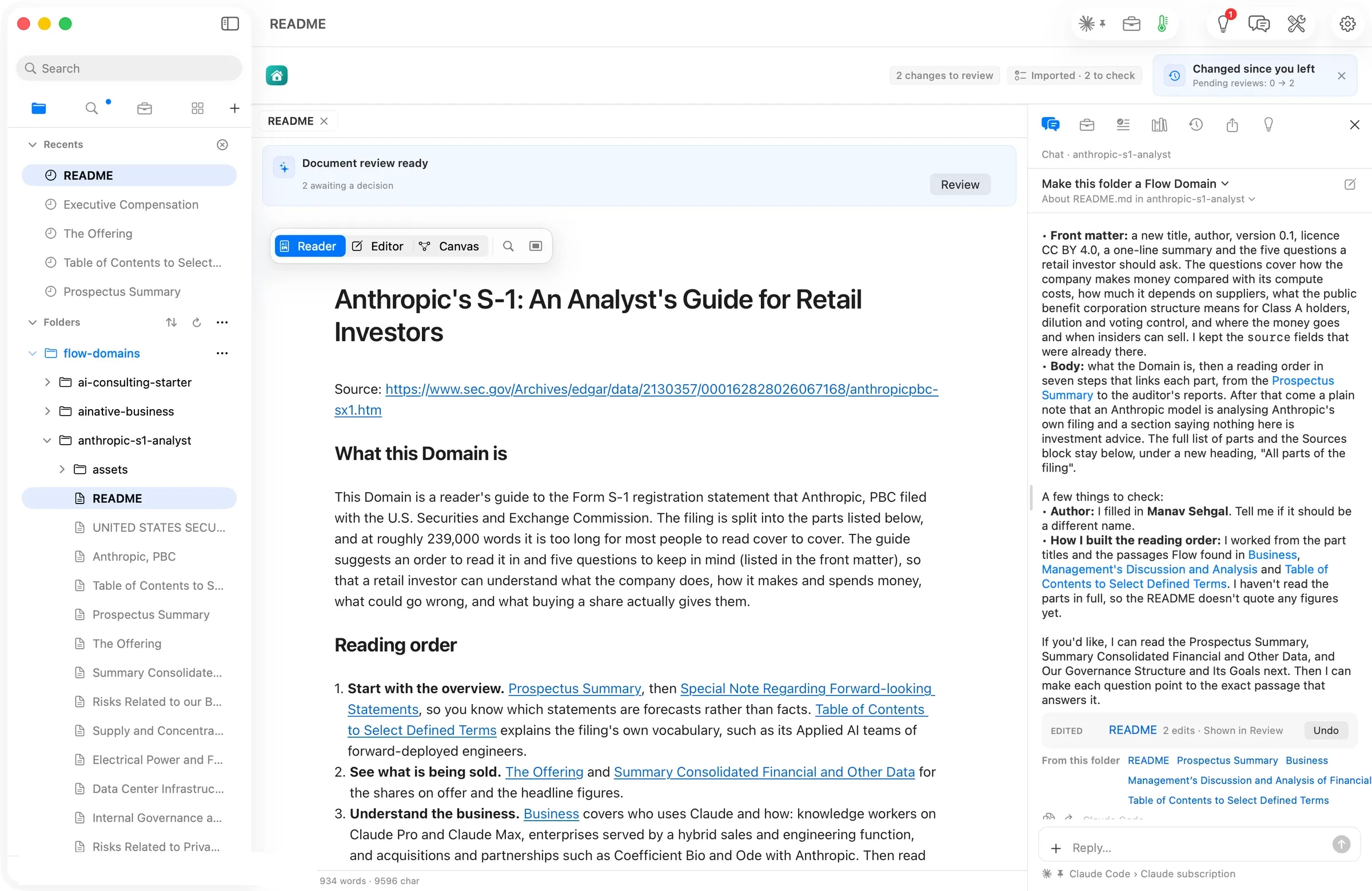
Anthropic's S-1 is about 243,000 words on one web page. That is far too long to read in one sitting, and too long to open as one document. Flow brought it in as 38 linked parts with its 42 pictures. Chat wrote the guide's front page. Ideas offered a figure wherever a section argues something, and each came back in under a minute. Three hours after the first step, Manav Sehgal's own reading of the filing was published as a Flow Playbook that anyone can bring into Flow.
What Flow does
Bring in a document too long to read. Publish your own guide to it the same day. Orionfold Flow turns a long web page into a folder you can work in. File ▸ New from Web Page reads the page. Past 40,000 words it tells you so. Too long for one document. Flow will bring it in as 38 documents. One button brings in every part. Each part keeps the page’s address as its source, with its pictures beside it. Ask Chat to make the folder a Playbook, and it writes the README. That page says what the folder is, who wrote it, its licence, the order to read it in and the questions it answers. Then Ideas goes section by section and offers a skill wherever a picture would say it faster. Your reading of the document becomes a figure in it, and you keep or discard each one in Review Changes. When the guide is ready, Publish sends the folder to GitHub. Anyone can bring it into Flow from there and ask it questions. The filing stays the source. The guide is yours.
The answer first
- Make a folder for the Playbook in the sidebar. Here it is
anthropic-s1-analyst, inside a folder for your Playbooks. - Choose File ▸ New from Web Page, paste the page’s address, and read it. Past 40,000 words, Flow offers Bring In All 38….
- Untick in a new folder so the parts go straight into your Playbook’s folder, then press Add. The parts arrive with a README that lists them.
- Select the folder and press ⌘K. Ask Chat to make the folder a Playbook. It writes a README with a title, author, version, licence, summary, the questions the Playbook answers, a reading order, and the notes a reader should see first. Keep it in Review Changes.
- Open Ideas (⌘3) on a part. Press a suggestion, read the skill’s sheet, and press Run Skill. Keep or discard what it draws in Review Changes. Repeat wherever a figure helps.
- Switch the README to Canvas to see what the Playbook is made from and what depends on it.
- Choose Publish ▸ GitHub Repository, type
owner/name/folder, and press Publish to GitHub. Others bring it in with File ▸ New from GitHub….
The job
A public filing is written for regulators and lawyers. A retail investor wants five things from it. How does the company make money? What does it depend on? Who controls it? What does a share buy? What could go wrong? The answers are all in there, spread across a quarter of a million words. Reading it once takes a weekend. Writing down how you read it, so someone else can follow, is a second job most people never get to. And a PDF of notes loses the filing it came from.
A Playbook keeps both. It holds the source, in parts you can open, and your reading of it, as documents that link back. Because a Playbook is a folder of Markdown files, it publishes as one. The person who brings it in gets the same parts, the same guide and the same links.
Bring in a page too long for one document
New from Web Page read the S-1 from its sec.gov address and counted the words before writing anything. Past 40,000 words, it offers a folder instead. That is the length where Flow measured typing starting to lag. Bring In All 38… lists the parts under the filing’s own sections. Each part is named for its heading and carries the page’s address in its front matter. The pictures it shows sit in an assets folder.
The task’s footer adds the parts to the folder you choose. With in a new folder ticked, they go into a subfolder named for the page. Unticked, as here, they land in the Playbook’s own folder. That is what made this folder a Playbook rather than a folder inside one.
The parts are a snapshot. Flow brings them in once, and Keep it updated has no effect on them yet.
Chat writes the front page
With the folder selected, Chat works inside it. New files land there, and Chat can read and change any document in the folder. Asked to make the folder a Playbook, it rewrote the README the split had made. It added front matter with a title, an author, a version, a licence and a summary. It added five questions a retail investor should ask of this filing. The body says what the Playbook is and sets a reading order in seven steps. It also names a conflict a careful reader would raise. An Anthropic model is analysing Anthropic’s own filing. The README says so, and says that nothing in it is investment advice. The full list of parts stays at the end.
Every link in the reading order opens a part that exists. Chat was also plain about how it built the order. It worked from the part titles and three parts it read, not from all 38. Check its order against the parts before you rely on it. The README is the one document worth reading closely, because every reader starts there.
Ideas finds where a picture would say it faster
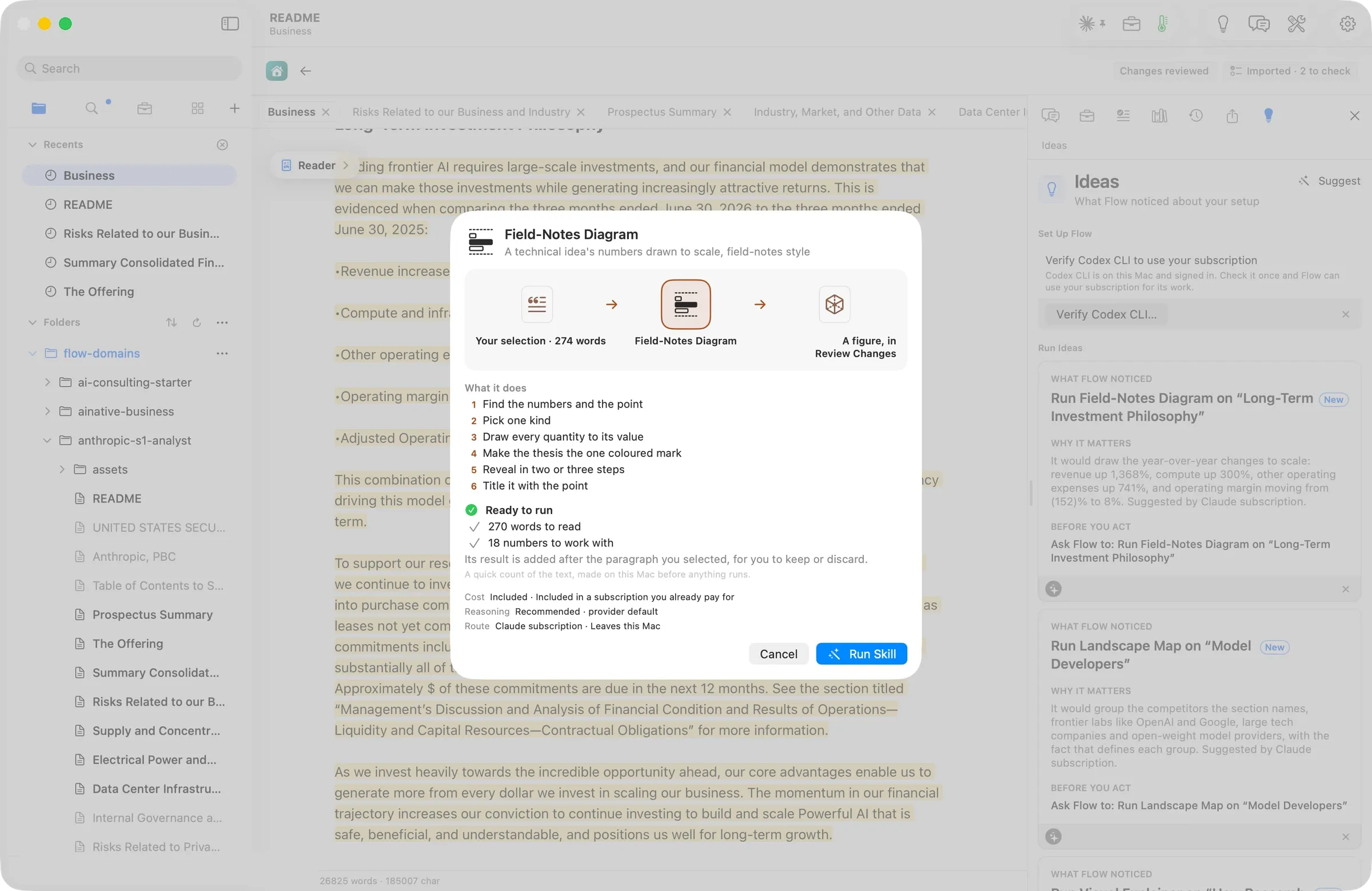
Ideas (⌘3) reads the part you have open and suggests what would help, section by section. Each suggestion says why it matters. In this Playbook every suggestion was a skill. There was a diagram for the governance section, an explainer for the two growth loops, a to-scale figure for the investment numbers, and a map of the competitors. Pressing one selects its section and opens the skill’s sheet. The sheet shows what it will read, the method’s steps, and a check of what the text holds (18 numbers to work with). It also shows what the run costs. Here it was included in a Claude subscription the author already pays for.
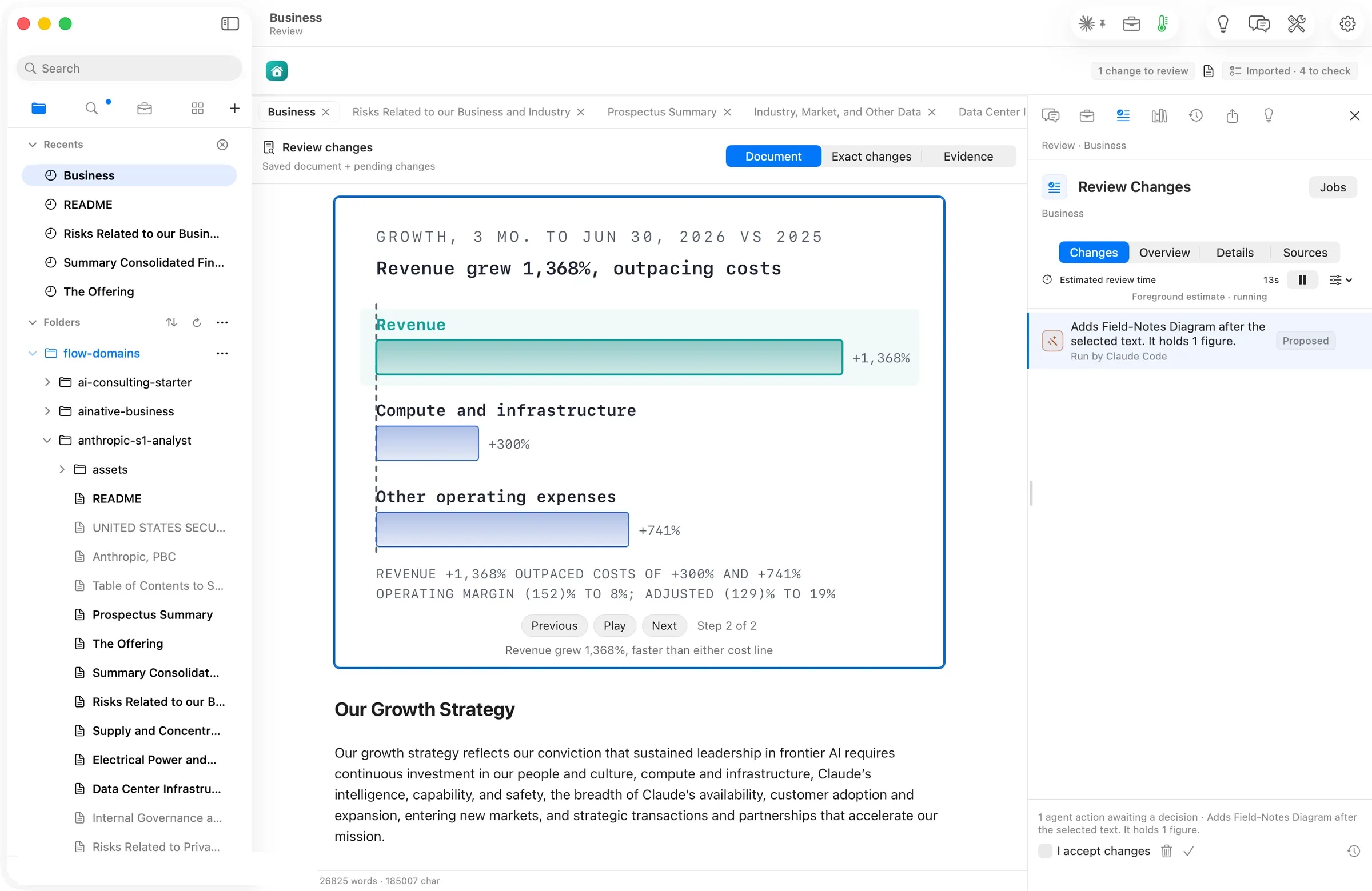
The figure arrives right after the section it read, waiting in Review Changes. Each bar is its number drawn to scale. In the shot the three bars measure in the same proportion as 1,368, 300 and 741. The bar the passage stresses is the one in colour. All three percentages appear, word for word, in the filing’s Business section. A reader who doubts the picture can check it against the paragraph above it.
Your reading of the filing, drawn
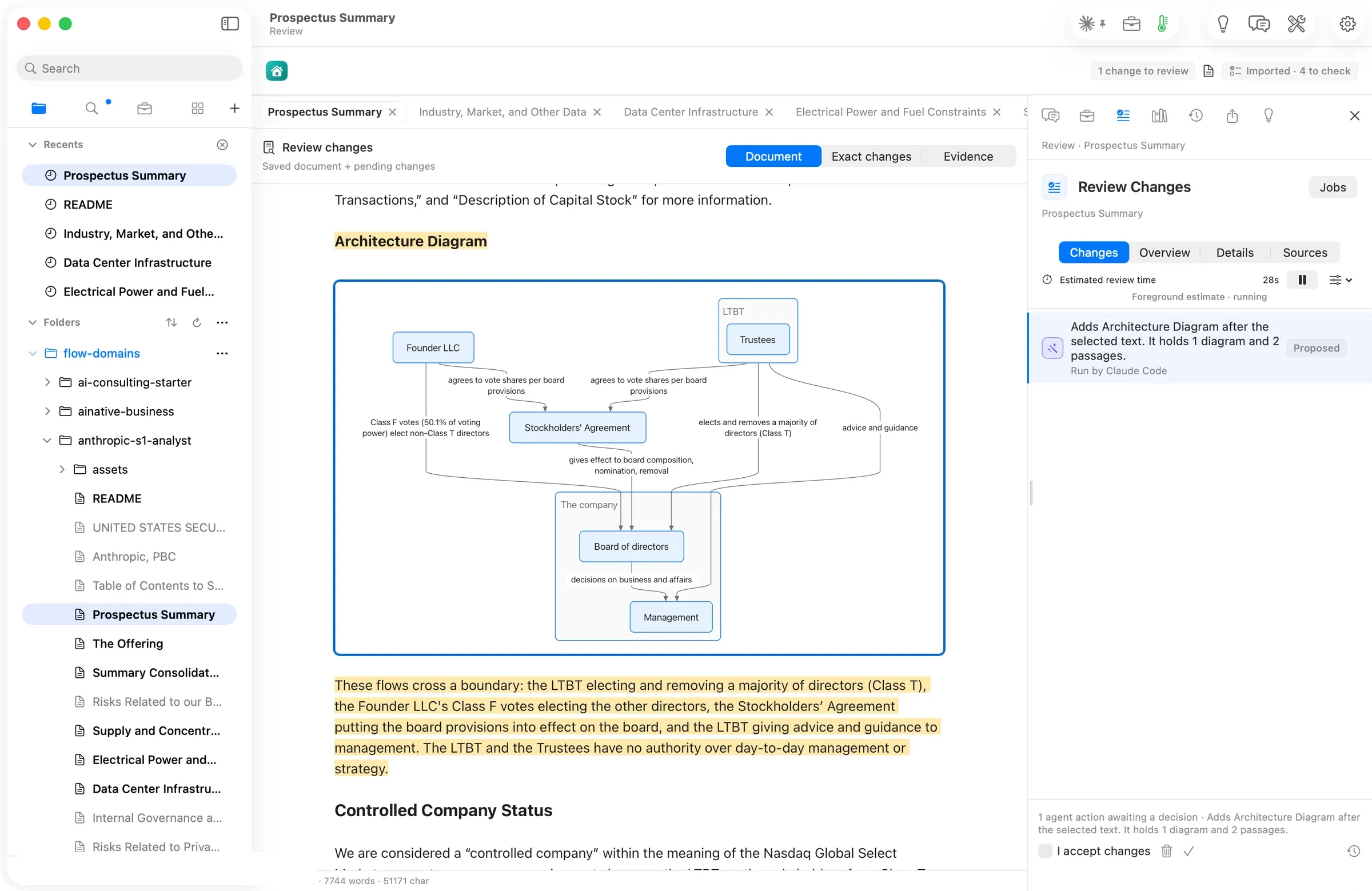
Architecture Diagram turned 315 words on board governance into the picture a reader wants. It shows who elects whom. The Founder LLC holds Class F votes. The Long-Term Benefit Trust can elect and remove a majority of directors. The Stockholders’ Agreement puts it into effect. Under the diagram, one passage names what crosses each boundary. From pressing the idea to seeing the diagram in Review took under 40 seconds. A Visual Explainer on the filing’s Self-Reinforcing Loops came back just as fast. It builds in five steps, from enterprise adoption to reinvestment in Claude, and you step through it with Previous, Play and Next.
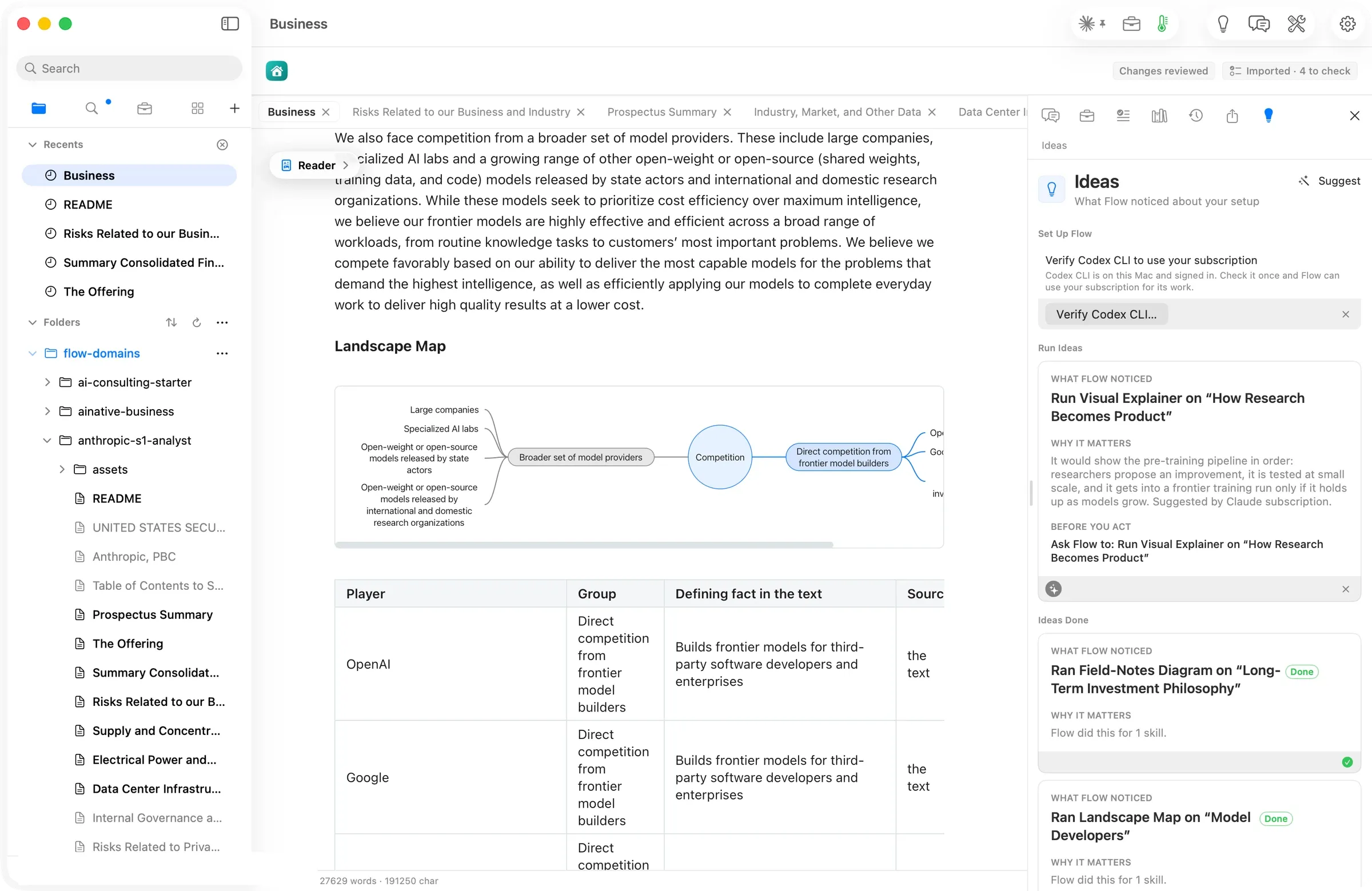
Landscape Map read the Competition section. It drew who Anthropic says it competes with, in two groups, with a table of each player and the fact the filing gives for it. A map wider than the column scrolls sideways, as this one does. To avoid that, select fewer players or read the table under it.
Each figure is saved in the document as text. It opens in any Markdown editor, prints when you publish, and travels with the Playbook.
What the guide knows that the filing does not say
A Playbook earns its place when it tells a reader something the source does not hand them. By the end of the afternoon the README alone had grown to 4,629 words. Most of those words are the author’s reading, not the filing’s text.
- Five questions, each answered across the whole filing. Take Is revenue growing faster than the cost of the compute behind it? The answer draws on the summary financials, the prospectus summary and the business section at once. Each fact links to the part it came from. One answer gathers what the filing spreads over thousands of words.
- Comparisons the filing leaves to the reader. Set the filing’s own figures side by side. The first half of 2026 is the first period in its table where revenue ($16,286 million) is larger than compute and infrastructure cost ($8,945 million). The README says so in one line, and a reader can check it against the table it cites.
- A list of what is still blank. This is the first S-1, and many of its figures stay empty until the offering is priced. That includes the price range, the share counts, dilution, the capitalisation table, the total of compute commitments and the lock-up releases. The README lists ten of these gaps. For each one it gives what the filing says and where to look next, such as a later amended filing or the final prospectus. “The filing is incomplete” becomes a checklist for the next amendment.
- Figures drawn from the numbers. Cash on hand against capital raised. Revenue against costs. Growth rates to scale. Who elects the board. Who Anthropic competes with. Each figure comes from the filing’s own words and sits next to the passage it reads. The summary financials alone carry seven charts.
- The reader’s warnings, in the open. Claude helped draft the guide, and the filing is Anthropic’s own. The README calls that a plain conflict of interest. It tells the reader to weigh the risk factors and the financial statements over any summary, and says that nothing in it is investment advice.
The filing stays untouched in its parts. Everything above is the author’s layer on top of it, and every claim in that layer points back to the part it rests on.
See what the Playbook is made of
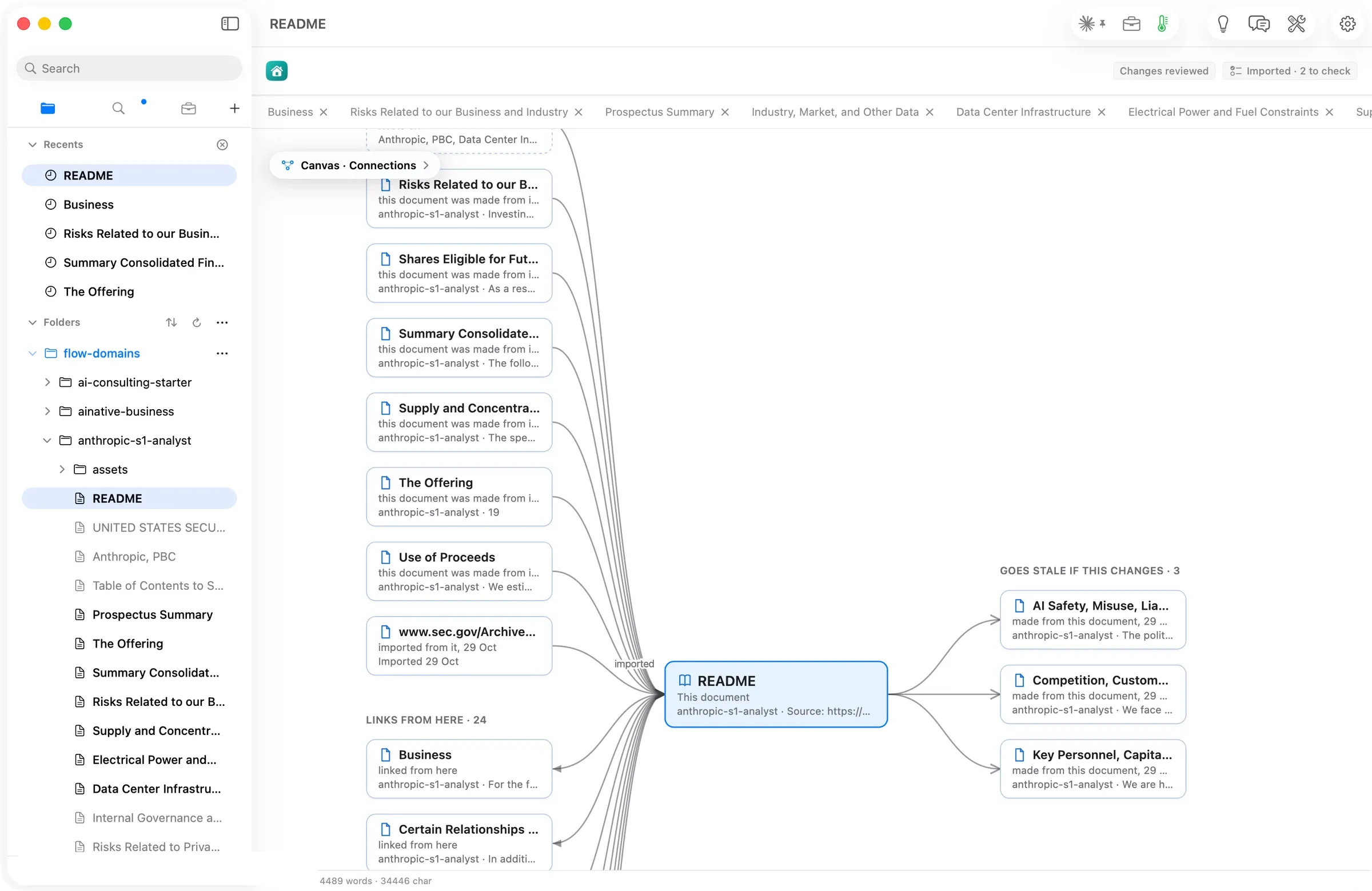
Switched to Canvas ▸ Connections, the README shows where it came from. On the left are the parts it was made from and the sec.gov page they were imported from on 29 October. Next come the 24 parts its reading order links to. On the right is what goes stale if the README changes, three documents that were made from it. A reader who wants to know where a sentence in the guide came from can follow it back to the filing.
Publish it as a Flow Playbook
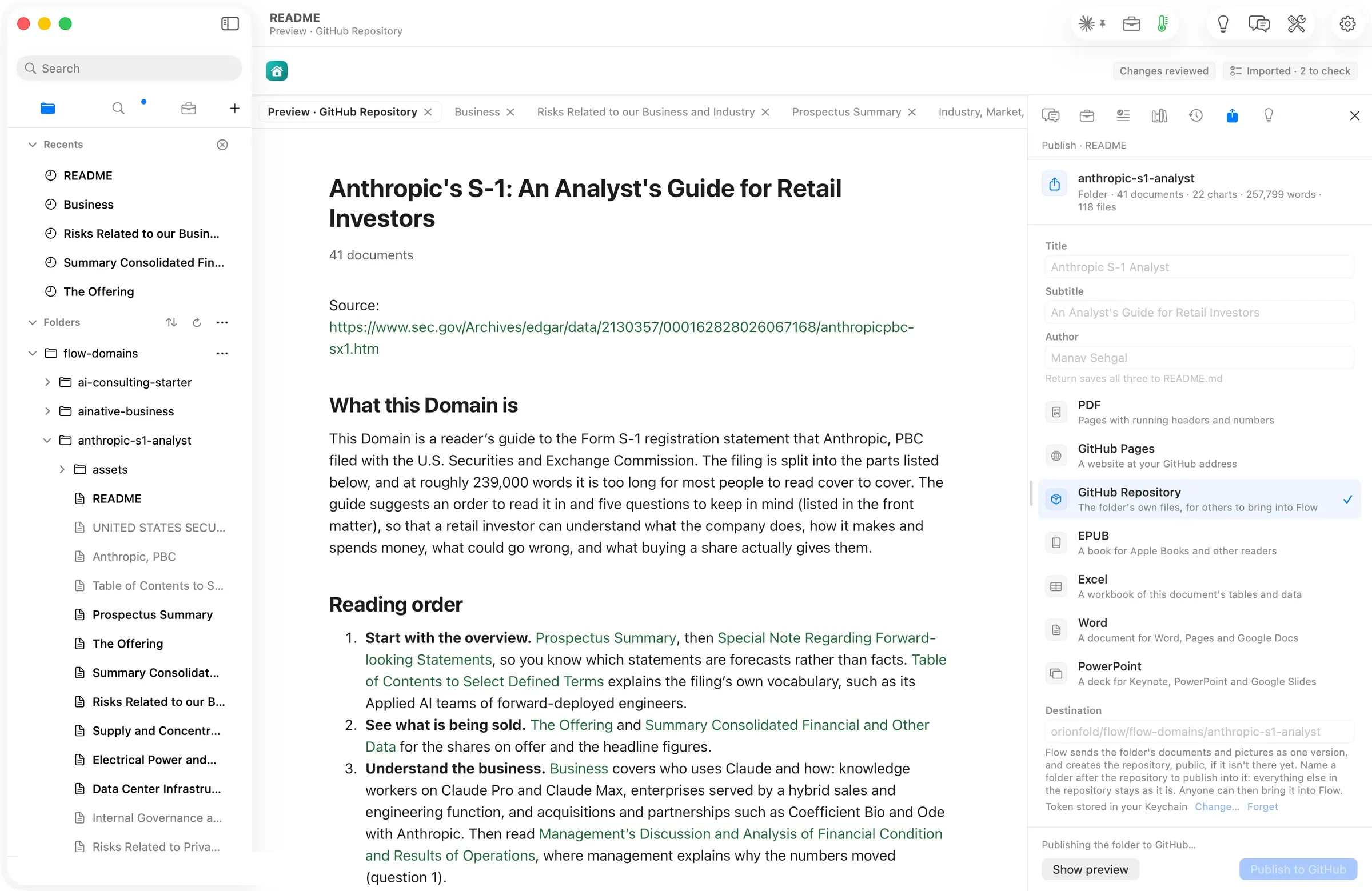
Publish ▸ GitHub Repository sends the folder’s documents and pictures, as one version, into the repository and folder you name. Every other file in that repository stays as it is. The title, subtitle and author you type are saved to the README. The token needs one permission on that repository, Contents: Read and write. GitHub adds Metadata itself. The publish landed as one commit of 84 files, and every one matched the file on the author’s Mac byte for byte. Flow’s own bookkeeping files stayed behind.
A reader gets the whole Playbook, with the parts, the guide and the figures. Publishing the full text of a public filing is the author’s choice. A guide can just as well link to the source and quote only what it draws.
What a Playbook gives the person who brings it in
This walk ended at the publish. The rest of what a Playbook offers already ships in Flow, though none of it was used on this Playbook today.
- They bring it in with one address. File ▸ New from GitHub… takes
github.com/orionfold/flow/tree/main/flow-domains/anthropic-s1-analyst. It shows how many files the Playbook holds, its version and its licence, and opens it on its README. When the author publishes a new version, a blue arrow appears beside the folder in the reader’s sidebar. They see what changed, document by document, and nothing changes until they choose. - Chat answers from the Playbook, not from memory. Before each reply, Chat searches the folder for the question and answers from the passages it finds. It links each fact to its part and lists those parts under From this folder. When the folder does not say, Chat says so. Because this README carries a title and questions, an empty Chat on it reads Answers from the Playbook’s title and offers its questions as buttons.
- Search finds every mention. Search (⇧⌘F) looks across every part at once. Similar to… lists the parts that share rare words with the one open. A risk named in the summary can be found in its full section.
- Their own agents can read it. With Flow Pro, Settings ▸ General ▸ Your agents opens a door for the Claude Code or Codex they run in Terminal. The agent can read a Playbook’s summary and reading order, search its documents, and propose a new one. The proposal arrives in Review Changes under the agent’s name, to keep or revert.
A filing read once is gone by next week. A filing turned into a Playbook can be asked, searched, handed to an agent and updated, by anyone the author shares it with.
The numbers
| Figure | Value | Status, and how we know |
|---|---|---|
| The page | 14,169,255 bytes, about 243,000 words | verified. The size by curl on 2026-10-28, the words by a scripted count of the page’s text |
| As one document | 255,297 words | verified. The Editor’s status bar after a one-document add on this walk |
| One document’s budget | 40,000 words | verified. Flow’s measured setting, from a bench of open and typing times |
| Brought in | 38 parts and the README, 42 pictures | verified. The folder listed on disk at 15:22 |
| The README | front matter with five questions, a seven-step reading order, every link resolving | verified. The file read back and each link checked on disk |
| Architecture Diagram | idea pressed to diagram in Review in under 40 seconds | verified. Shot times 17:42:04 and 17:42:42 |
| Visual Explainer | under 40 seconds | verified. Shot times 17:43:57 and 17:44:35 |
| Field-Notes Diagram | 18 numbers read, bars in the proportion 1,368 to 300 to 741 | verified. The sheet, the bars measured on the capture, the numbers found in the part’s text |
| The README at the end | 4,629 words, five questions answered with links to their parts, a list of 10 blank figures | verified. The file read back at 18:20 |
| Revenue above compute cost | first in the first half of 2026, $16,286 million against $8,945 million | verified. The README’s figures, each linked to the summary financials. Earlier periods 41 against 433, 386 against 2,522, 4,585 against 7,326 ($ millions) |
| Charts in the summary financials | 7 | verified. The chart blocks counted in the part |
| Published | 84 files in one commit, 6:10 PM | verified. GitHub’s API for the commit and its files |
| Files equal to the author’s | 84 of 84 | verified. Each file’s GitHub hash against the file on the Mac |
| Folder at publish | 41 documents, 22 charts, 257,799 words | verified. The Publish panel |
| Elapsed | about three hours, first step to published | verified. The walk’s journal (15:05 to 18:10). The walk paused between steps while the build was refined, so the author’s own working time is less, and unknown |
| Spend | $0 in API charges | verified. Every run on Claude Code with the Claude subscription, each sheet reading Included |
| New from GitHub, Chat from the folder, Search, Your agents | as described above | assumed. Shipped and described in Flow’s changelog, not walked on this Playbook |